
The right configuration comes down to what you are moving, where you are moving it, and how your truck-and-dog combination needs to perform day-to-day. A tri-axle dog trailer suits operators who need flexibility, lower tare weight and manoeuvrability. A quad-axle suits those who regularly carry heavier loads and need the higher aggregate trailer mass the extra axle group provides.
Neither option is automatically the better choice. If manoeuvrability and lighter tare weight matter more, the tri-axle is likely the stronger fit. If you need a higher aggregate trailer mass for consistent heavy work, the quad-axle is worth the additional cost.
| If this matters most | Likely better fit |
|---|---|
| Manoeuvrability | Tri-axle dog trailer |
| Lower tare weight | Tri-axle dog trailer |
| Higher aggregate trailer mass | Quad-axle dog trailer |
| Heavier regular loads | Quad-axle dog trailer |
| Tighter urban sites | Tri-axle dog trailer |
| Reducing trips on high-volume work | Quad-axle dog trailer |
Not sure which configuration suits your work? Speak with the West-Trans team for practical advice based on your truck, payload and routes.
The Main Difference Between Tri-Axle and Quad-Axle Dog Trailers
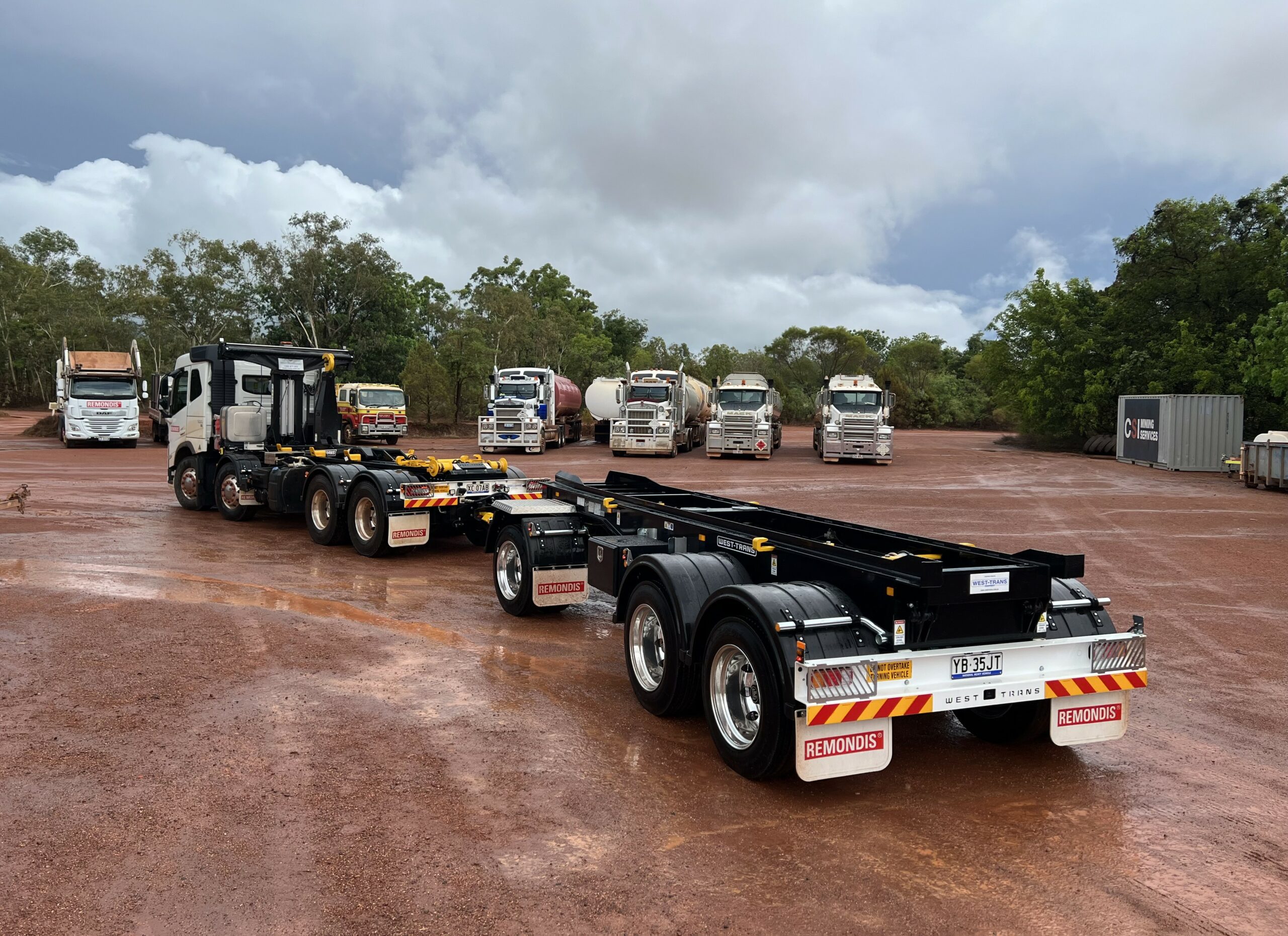
A tri-axle dog trailer has one axle at the front on a turning dolly and two axles at the rear. A quad-axle dog trailer has two axles at both the front and rear. That extra axle group is what drives the practical differences in aggregate trailer mass, tare weight and how the combination handles across different sites and routes.
West-Trans’ tri-axle dog trailer has an aggregate trailer mass of 25,500 kg and a tare weight of approximately 4,800 kg. The quad-axle sits at 35,000kg aggregate trailer mass at roughly 5,800kg tare. Both share a 22,000kg tipping capacity. Please note that, regardless of the aggregate trailer mass, the trailer mass will be limited by local axle load limits (refer to the NHVR mass limits).
The choice is not simply three axles versus four. It is a question of whether your operation benefits more from lower tare weight and manoeuvrability, or from higher aggregate trailer mass and added load support.
Payload, Tare Weight and Aggregate Trailer Mass Compared
These three figures determine how much usable payload your dog trailer can actually carry, and they interact in ways worth understanding before you choose.
- Tipping capacity is the rated load limit when tipping.
- Aggregate trailer mass is the maximum total loaded mass for which the trailer is rated.
- Tare weight is the approximate empty weight of the trailer itself. A lighter tare weight means more of your allowable mass goes toward payload.
| Specification | Tri-Axle Dog Trailer | Quad-Axle Dog Trailer |
|---|---|---|
| Tipping capacity | 22,000kg | 22,000kg |
| Aggregate trailer mass | 25,500kg | 35,000kg |
| Approx. tare weight | 4,800kg | 5,800kg |
| Practical strength | Lighter, more manoeuvrable | Higher aggregate mass, added support |
| Best suited to | Flexible mixed-use operations | Heavier, higher-volume operations |
A higher aggregate trailer mass rating does not automatically mean a higher legal payload on every route. Usable payload depends on the truck’s GVM and GCM, axle spacing, route access, and whether you are operating under general mass limits, an exemption notice, permit or PBS approval. The quad-axle may offer greater rated capacity, but it only makes sense if your operation can legally and consistently use that capacity across your actual routes.
Manoeuvrability, Site Access and When the Extra Axle Pays Off
Truck and dog combinations are not short vehicles. The manoeuvrability difference between a tri-axle and quad-axle dog trailer is real, but the bigger factor for most operators is the overall combination length. That said, a tri-axle dog trailer is generally more manoeuvrable and better suited to tighter environments, given its lighter tare weight and fewer axle components. For skip bin operators on suburban streets, waste contractors navigating transfer facilities, or any business where site access is regularly constrained, the tri-axle is often the more practical daily choice.
The quad-axle suits open sites, regional routes and operations where loads are consistently heavy. For the extra-axle group to deliver a return, the higher aggregate trailer mass must be used regularly.
Consider how many repeat trips per shift a quad-axle could realistically eliminate, and whether your routes and compliance pathway support the heavier configuration. If most loads remain within the tri-axle capacity, the additional tyre wear, brake maintenance, and running costs are unlikely to be offset by productivity gains.
Australian Compliance Considerations
Under the Heavy Vehicle National Law (HVNL), dog trailers must not exceed the mass of the towing vehicle. When towed by a 3-axle rigid truck as a non-PBS vehicle, the combination has a maximum length of 19 metres. Additional length and mass limits apply depending on the axle configuration and whether the vehicle operates under general access conditions, an exemption notice, a permit, or PBS approval.
For operators seeking access to higher mass limits or gazetted networks, the NHVR’s national notices cover truck-and-dog combinations under both PBS and non-PBS frameworks. Before choosing based solely on aggregate trailer mass, confirm your full truck-and-trailer combination, route access, mass limits, and operating conditions.
When truck matching, cross-border routes, PBS access or a custom build are part of the picture, speak with West-Trans before purchasing.
Which Configuration Suits Your Work?
Waste and skip bin transport: Tri-axle dog trailers are generally well-suited to tighter metro sites and mixed daily workloads. Quad-axle configurations may be justified where reducing trips for heavier waste streams is a consistent priority.
Construction and demolition: Quad-axle suits heavier materials and high-volume movement between sites. Tri-axle remains practical where site access is tight, or loads vary across the day.
Civil and bulk materials: A quad-axle is typically more attractive when aggregate trailer mass and trip reduction are the key drivers, provided routes and compliance requirements support the combination.
Urban and tight-access work: A tri-axle is generally the easier choice to justify when manoeuvrability and lower tare weight matter more than maximum carrying capacity.
Why Speak With West-Trans Before Choosing?
West-Trans manufactures customisable dog trailers purpose-designed for Australian operators, available across Sydney, Melbourne, Brisbane and Perth. Both configurations are built from high tensile steel by specialist engineers, with tipping and non-tipping options available to suit different operational requirements.
The right choice depends on your truck setup, typical payload, work type, operating routes, site access conditions and compliance pathway. Get in touch with the West-Trans expert team to find the right setup for your fleet.
Frequently Asked Questions
What is the main difference between a tri-axle and a quad-axle dog trailer?
The main differences are axle configuration, tare weight, aggregate trailer mass and manoeuvrability. A tri-axle has one axle at the front on a turning dolly and two at the rear. A quad-axle has two axles at both front and rear, offering higher aggregate trailer mass and added stability at the cost of some manoeuvrability and a heavier tare weight.
Is a quad-axle dog trailer better than a tri-axle dog trailer?
Not always. A quad-axle suits operators who regularly carry heavier loads and need a higher aggregate trailer mass. A tri-axle is often the stronger choice for mixed workloads, tighter sites, and operations where manoeuvrability and lower tare weight deliver more practical value day-to-day.
Which dog trailer has the higher aggregate trailer mass?
West-Trans lists its quad-axle dog trailer at 35,000kg aggregate trailer mass, compared with 25,500kg for the tri-axle. Both share a 22,000kg tipping capacity.
Does a higher aggregate trailer mass always mean I can legally carry more?
No. Legal carrying capacity depends on the full truck and dog combination, axle spacing, gross combination mass, route access, and your operating approval, whether that is general limits, an exemption notice, a permit, or PBS approval.
Can West-Trans customise tri-axle and quad-axle dog trailers?
Yes. West-Trans offers customisable dog trailers in both tipping and non-tipping configurations to suit specific operational requirements. Contact the West-Trans team to discuss a build suited to your fleet.