
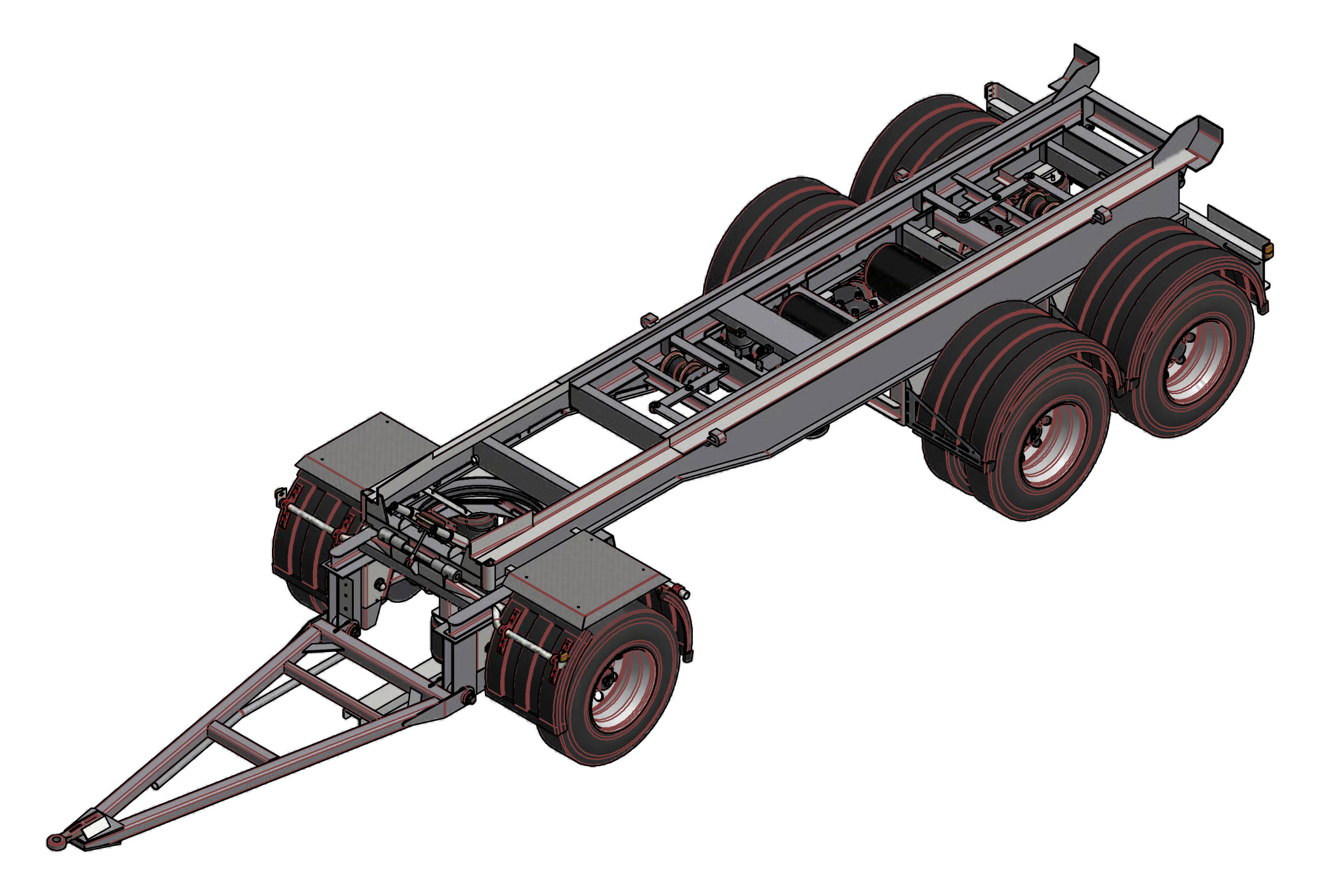
Adding a dog trailer to a hook-lift truck is a practical way to increase capacity and cut down on repeat trips. Whether the pairing works depends on a lot more than whether the truck can physically tow a trailer. The full combination needs to suit the truck’s ratings, the loads being carried, the sites being worked, and the compliance requirements for the routes being run. Get those right, and a truck-and-dog setup can deliver real productivity gains. Get them wrong, and you are dealing with a combination that underperforms, costs more to operate, or fails to meet legal operating requirements.
Can You Pair a Dog Trailer with Any Hook Lift Truck?
In short, no, you cannot. The lowest-rated component in the combination determines its safe working limit, so even a truck with plenty of power and towing capacity on paper can be unsuitable if the gross combination mass rating, coupling, drawbar, axle configuration, or route access does not support adding the trailer. The aim is not the largest trailer that will physically attach. It is a combination that safely and legally carries the right payload across the routes and sites it operates on every day.
Start with the Truck Specifications
Before any trailer is chosen, the truck’s figures need to be confirmed. Gross vehicle mass is the maximum rated loaded mass of the truck on its own. Gross combination mass is the maximum rated mass of the truck and trailer combined. The gap between GCM and the truck’s loaded mass determines available towing capacity.
The hook lift body, chassis, wheelbase, axle configuration and tare weight all contribute to the truck’s loaded mass. A truck that handles well as a solo unit may not suit a truck-and-dog configuration once those figures are properly accounted for. Before speaking with a supplier, confirm:
- Truck make and model
- GVM and GCM (from data plate)
- Axle configuration and wheelbase
- Hook lift model
- Typical bin sizes
- Material types usually carried
- Usual route and site conditions
Match the Dog Trailer to the Load You Carry
A trailer’s aggregate trailer mass rating sets the ceiling, but the materials being carried determine how quickly that ceiling is reached. Dense loads like concrete rubble, scrap metal, wet soil and quarry aggregate hit weight limits well before filling a bin. Lighter materials, such as green waste or general rubbish, may fill the bin before weight becomes the constraint.
A trailer sized for the heaviest occasional load will add tare weight, tyre wear and running costs on every other shift without a corresponding return. Match the setup to typical work, and confirm whether the trailer needs to tip or is primarily used for bin transport.
Check Coupling, Drawbar and Connection Compatibility
The connection between the truck and trailer is a critical compatibility point. In Australia, truck-and-dog combinations use a bolt coupling device and a drawbar, with the towing eye entering the coupling mouth during connection. A tug test should always be performed after coupling to confirm secure engagement. Air lines connect to the trailer’s braking system, and electrical leads carry signals to the indicators, brake lights, and tail lights.
Each of these connection points carries its own rating. The coupling, tow bar, drawbar and trailer coupling all need to be rated for the intended operation, and the lowest-rated component limits the whole combination. Drawbar length and articulation also affect turning clearance and handling.
Axle Configuration and How It Affects the Pairing
Axle choice affects tare weight, aggregate trailer mass, manoeuvrability and load support. West-Trans offers both configurations, and the differences are worth understanding before settling on a setup.
| Tri-Axle | Quad-Axle | |
| Front axle group | One axle on a turning dolly | Two axles |
| Rear axle group | Two axles | Two axles |
| Aggregate trailer mass | 25,500 kg | 33,000kg |
| Approx. tare weight | 5,900kg | 6,500kg |
A tri-axle tends to suit mixed-use and tighter-access operations. A quad-axle suits heavier, higher-volume work where the truck, route and compliance pathway support the extra capacity. More axles add rated mass and load support, but also tare weight, tyre wear and maintenance costs. The additional capacity only pays off when the operation can regularly and legally use it.
Australian Compliance, Mass Limits and Route Access
Compliance should be confirmed before equipment is chosen. Under the Heavy Vehicle National Law, dog trailers must not exceed the mass of the towing vehicle. Combination length limits, axle mass limits and route access conditions vary depending on whether the combination operates under general access, an exemption notice, a permit, or Performance Based Standards approval.
A trailer’s aggregate trailer mass rating does not automatically equal usable legal payload on every route. The full combination, including the truck’s GCM, axle spacing, route access and applicable approval, determines what can actually be carried. For operators working across state borders or on routes with specific access conditions, NHVR and relevant state road authority guidance should be checked before finalising the setup.
Manoeuvrability, Site Access and Daily Workflow
Hook lift trucks are already long vehicles, and adding a dog trailer makes the combination considerably longer. For skip bin operators on suburban routes, the ability to reverse into driveways and navigate residential streets can be a more significant daily constraint than payload capacity. Turning circle, reversing space, loading zone dimensions, and site gradients are all worth thinking through. A combination that saves two trips per shift will not deliver that saving if it creates manoeuvring problems on every site visit.
Load containment is also a practical consideration. West-Trans tarping systems are available for both hook lift bins and dog trailers, keeping loads covered and compliant during transport. Braking system compatibility, suspension, lighting and bin locking systems should all be confirmed as part of the complete setup.
A Practical Pairing Checklist
Before committing to a setup, confirm:
- Truck GVM and GCM (from data plate)
- Hook lift model and existing body setup
- Trailer ATM, tare weight and axle configuration
- Coupling, tow bar and drawbar ratings across all components
- Typical payload, material type and bin sizes
- Tipping or non-tipping requirement
- Route access, operating conditions and compliance pathway
- Tarping, braking, suspension and load restraint requirements
Why Speak with West-Trans?
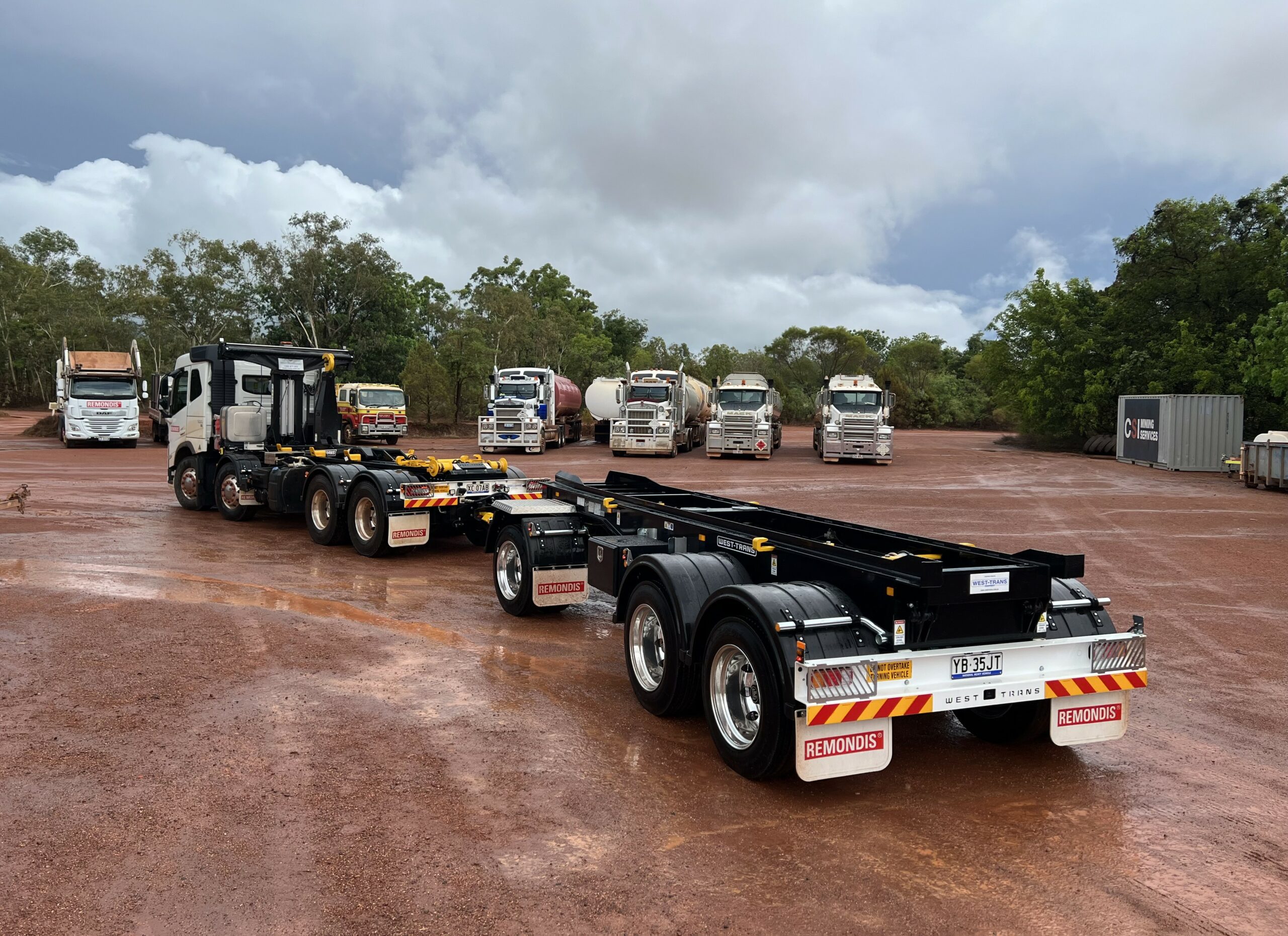
West-Trans manufactures both hook lifts and dog trailers for Australian operators, so the team understands how the two components of the combination need to work together. Dog trailers can be built to suit specific operational requirements, including tipping and non-tipping configurations, bin-locking systems, and custom deck designs. The West-Trans team supports operators across Sydney, Melbourne, Brisbane and Perth.
Get in touch with our friendly team and share your truck details, typical load types, bin sizes and route conditions. We can help you find the right setup for your operation.
Frequently Asked Questions
Can any hook lift truck tow a dog trailer?
No. A dog trailer needs to be matched to the truck’s GVM, GCM, coupling, drawbar rating, axle configuration and route conditions.
Does a higher aggregate trailer mass mean I can carry more payload?
Not automatically. Legal payload depends on the full combination, including the truck’s GCM, axle mass limits, route access and applicable compliance pathway. ATM is a rated maximum under the right conditions, not a guaranteed usable figure on every route.
Is a tri-axle or quad-axle dog trailer better for a hook lift truck?
It depends on the operation. A tri-axle is well-suited to mixed-use and tighter-access work. A quad-axle suits heavier, higher-volume operations where the truck and route support the additional capacity.
Do I need a tipping dog trailer with a hook lift truck?
Only if the operation requires tipping loose materials from the trailer. Some operators find a non-tipping trailer sufficient because the hook lift handles all unloading. This decision is worth making early, as it affects the trailer design and hydraulic requirements.
Why speak with a specialist before choosing a dog trailer?
A specialist can confirm whether the truck, trailer, payload, bin setup and compliance requirements work together before you invest in a build. It is easier to get right before purchasing than to correct afterwards.