
If you’ve been looking at the West-Trans hook lift range and noticed the ‘A’ models cost more than their standard counterparts, you’re probably weighing up whether the price difference is justified. The answer comes down to where your trucks operate and what they’re picking up. An articulating jib earns its place on trucks that regularly work under low overhangs, inside covered depots, or on confined urban sites. A fixed jib suits open yards, regional runs, and operations where overhead clearance isn’t a concern.
The ‘A’ in models like the HL-6A, HL-10A, and HL-22A refers to an articulating jib, a jointed arm design that changes how the hook lift engages containers. The articulating jib is built into the frame and hydraulic design from the start, so it’s not something you can add later, which is why it’s worth thinking through before you commit.
What Does the Jib Actually Do?
The term ‘jib’ can cause some confusion online because most search results refer to overhead jib cranes, the kind used in warehouses and factories. On a hook lift, it’s something entirely different.
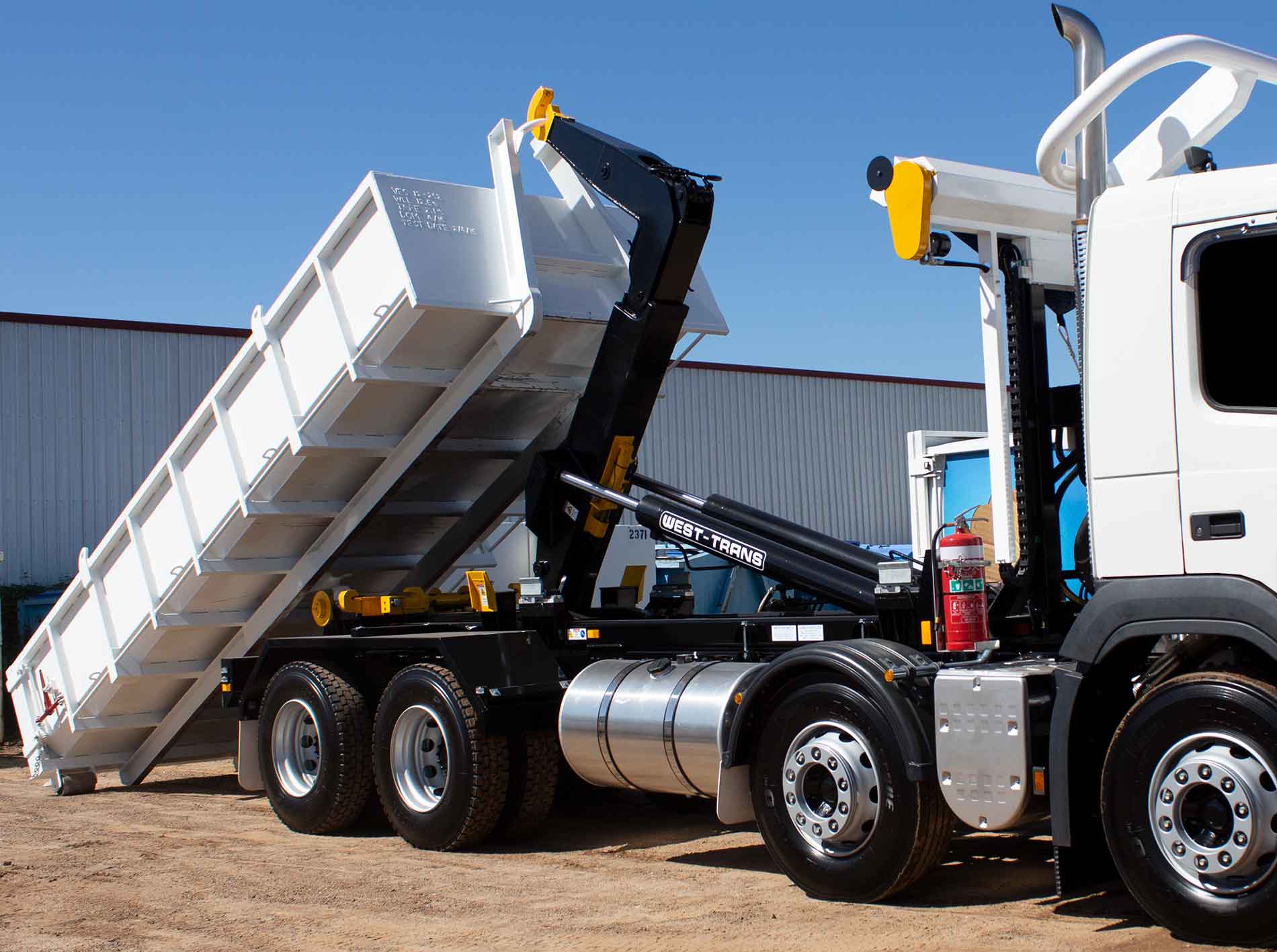
The jib is the arm mounted to the truck chassis. It extends outward via the extension cylinder, hooks onto the container’s hook bar, and pulls it up along the subframe while hydraulic locks hold everything secure.
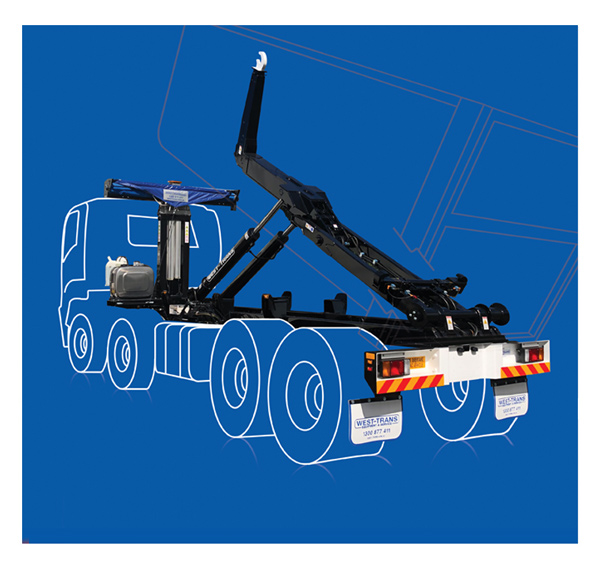
Both fixed and articulating hook lifts have a jib. The difference is in how that jib moves.
Fixed Jib
A fixed jib is a single rigid arm. When it extends to engage a container, it travels in a straightforward arc, up and over. It’s a proven, simple design with fewer moving parts.
Because the arm follows a wider arc during loading and unloading, a fixed jib hook lift needs more overhead clearance above the container and more open space behind the truck to complete the loading cycle. In a wide yard or open site, that’s no issue at all.
Articulating Jib
An articulating jib has a joint, an articulation point, partway along the arm. This allows the jib to fold as it extends, so the hook travels in a tighter, lower arc when engaging the container. That means less overhead clearance needed and more room to work in spaces where a fixed jib wouldn’t complete the loading cycle.
The trade-off is a more complex hydraulic system and a slightly heavier tare weight, since the articulation mechanism adds extra components to the arm.
Strengths and Limitations of Fixed Jib Hook Lifts
Fixed jib hook lifts are the workhorse of the range. They’re mechanically simpler, lighter, and more cost-effective, and for a lot of Australian operations, they’re all you need.
When A Fixed Jib Is The Right Call
If your trucks are working across open yards, highway haulage routes, regional tips, and sites where overhead clearance isn’t restricted, a fixed jib is the practical choice. The simpler hydraulic design means fewer potential failure points, lower tare weight, and lower maintenance costs over the life of the system.
Fixed jib models suit operators running consistent bin sizes in predictable environments. Regional waste contractors, rural councils, and construction firms working on open suburban or semi-rural development sites are typical users.
West-Trans Fixed Jib Models
| Model | Lifting Capacity | Hook Height | Bin Length | Tare Weight |
| HL-6 | 6,000kg | 900mm or 1,450mm | 3,000–4,800mm | 950kg |
| HL-10 | 10,000kg | 900mm | 4,000–6,000mm (std) / 4,500–6,500mm (long) | 1,450kg |
| HL-16 | 16,000kg | 1,450mm | 4,100–6,300mm | 1,950kg |
| HL-22 | 22,000kg | 1,450mm | 4,500–6,700mm | 2,700kg |
The HL-6 is the most compact in the range and the only fixed jib model that offers a choice of hook heights (900mm or 1,450mm), adding flexibility for operators running different container configurations.
Strengths and Limitations of Articulating Jib Hook Lifts
Articulating jib models were developed for sites where a standard fixed jib can’t complete its loading arc, whether that’s due to overhead obstructions or limited horizontal space.
How Articulation Changes The Operation
Rather than swinging up and over in a wide arc, the articulating jib folds through its joint, keeping the hook closer to the truck’s rear and maintaining a lower profile during engagement. That’s a significant operational advantage when you’re picking up containers under awnings, inside covered depots, beneath loading docks, or in narrow laneways where the truck can’t pull far enough forward after engaging a bin.
You’ll see articulated jib hook lifts used for inner-city construction waste removal in Sydney and Melbourne, at recycling and food waste facilities with covered loading docks, and on underground or basement-level construction jobs. In these environments, an articulating jib isn’t a luxury. Without one, the truck either can’t complete the load cycle safely or the operator ends up finding workarounds that cost time and create risk.
West-Trans Articulating Jib Models
The articulating range spans five models, with a greater variety at the heavier end of the scale:
| Model | Lifting Capacity | Hook Height | Bin Length | Tare Weight |
| HL-6A | 6,000kg | 900mm | 3,000–4,800mm | 1,150kg |
| HL-10A | 10,000kg | 900mm | 3,000–4,800mm | 1,250kg |
| HL-18A | 18,000kg | 1,450mm (adjustable) | 3,500–6,700mm | 2,700kg |
| HL-22A | 22,000kg | Adjustable | 3,500–6,700mm | 2,750kg |
| HL-26A | 26,000kg | Adjustable | 4,200–7,400mm | 3,390kg |
The articulating range extends beyond what’s available in fixed jib. There’s no fixed jib equivalent of the HL-18A or HL-26A, so if you need articulation at those capacities, the ‘A’ models are your only option in the West-Trans range.
Fixed vs Articulating Jib: At a Glance
| Factor | Fixed Jib | Articulating Jib |
| Overhead clearance required | Higher | Lower |
| Tare weight | Lower | Slightly higher |
| Mechanical complexity | Simpler | More complex |
| Ideal environment | Open yards, highway, rural/regional | Urban, covered depots, restricted sites |
| Relative cost | Lower | Higher |
| Maintenance | Less frequent, simpler servicing | More components to service |
| West-Trans models | HL-6, HL-10, HL-16, HL-22 | HL-6A, HL-10A, HL-18A, HL-22A, HL-26A |
The tare weight difference should be factored in. Compare the HL-6 at 950kg against the HL-6A at 1,150kg: that’s 200kg of additional tare. For operators running close to GVM limits, that 200kg comes directly off your payload. At the heavier end, the HL-22 and HL-22A are much closer (2,700kg vs 2,750kg), so the trade-off narrows as you move up the range.
Choosing Between the Two
Rather than getting caught up in specs alone, work through these four questions. They’ll point you toward the right configuration based on how your trucks actually operate day to day.
Where are your tightest operating conditions? If your trucks regularly operate under low overhangs, in covered depots, or on inner-city construction sites, an articulating jib will likely pay for itself in time saved and risk avoided. If your sites are predominantly open, a fixed jib handles the job without the added complexity.
What containers are you running? Fixed jib models suit standardised container rotations where the same bins go back and forth. If you’re running a wider variety of container sizes across diverse sites, the articulating jib’s flexibility can be an advantage.
Do you have overhead obstructions at your regular sites? If your regular sites have overhead constraints like loading docks, depot awnings, warehouse entries, or powerlines, a fixed jib may not be able to complete its loading arc. Even one or two restricted sites in your rotation could justify the move to an articulating model.
Are you prioritising fleet simplicity or operational flexibility? A fixed jib fleet is easier and cheaper to maintain. Fewer hydraulic components mean fewer potential failure points and simpler servicing. An articulating jib fleet offers greater versatility across a wider range of sites but comes with marginally higher maintenance requirements. Some operators run both configurations across their fleet, matching each truck to its primary operating environment.
Talk to the West-Trans Team
Every fleet is different, and the right jib configuration depends on where your trucks spend most of their time. If you want to talk through the specs for a particular operation, give the West-Trans team a call on 1300 877 411. We can help you match the right hook lift to the way your trucks actually work.
Frequently Asked Questions
Can I retrofit an articulating jib to a standard hook lift?
No. The articulating jib is a different frame and hydraulic design from the ground up, not an add-on. If you think articulation might be needed in the future, it’s far more cost-effective to spec the ‘A’ model from the outset than to face a full replacement later.
Does an articulating jib reduce lifting capacity?
The lifting capacity stays the same across paired models. The HL-6 and HL-6A both lift 6,000kg, and the HL-22 and HL-22A both lift 22,000kg. Where the difference shows up is in tare weight, which means slightly less available payload if you’re running near your GVM ceiling.
Is an articulating jib harder to maintain than a fixed jib?
There are more components to inspect and service due to the additional articulation joint and associated hydraulics. Regular servicing through West-Trans or an authorised dealer will keep either system running reliably. The important thing is maintaining a consistent servicing schedule regardless of which type you run.
What hook height do I need for standard Australian bins?
This depends on the container size and type. West-Trans hook lifts are available with hook heights of 900mm and 1,450mm, with adjustable options on selected models. Your West-Trans dealer can advise on the right hook height based on the containers you’re running.