
Get skip loader weight limits wrong, and you’re looking at fines, wrecked hydraulics, and project delays. The confusion starts because skip loaders have three different capacity numbers, and most operators don’t know which one actually matters for staying legal and keeping equipment intact.
Here’s what you need to know about skip loader capacities, Australian regulations, and how to avoid costly overloading mistakes.
What Skip Loader Weight Capacity Actually Means
Skip loader capacity isn’t one simple number. You need to understand three different measurements.
Lifting Capacity
This is what the hydraulic arms can lift. When West-Trans lists a DS-60s at 6,000kg, that’s the lifting capacity.
Skip Bin Capacity
Cubic metres tell you volume, not weight. A 4m³ bin filled with wet clay weighs around 6,640kg. That same bin filled with green waste might weigh 2,400kg. The bin size stays the same, but the weight changes massively based on what’s inside.
Gross Vehicle Mass (GVM)
GVM is your legal limit. If your truck has 10,000kg GVM and weighs 5,500kg empty (including the loader and skip bin), you’ve got 4,500kg available for material. That’s your real number, even if the loader can technically lift more.
Most operators get this wrong. They see “4,000kg capacity” and think they can load 4,000kg of material. You can’t. The skip bin weighs 200-400kg, depending on size, and that needs to be included in the total weight.
Australian Weight Regulations for Skip Loaders
Chain of Responsibility (CoR) laws apply to vehicles over 4.5 tonne GVM in NSW, ACT, Queensland, SA, Tasmania, and Victoria. WA and NT have similar rules under different legislation.
CoR means everyone shares responsibility for weight compliance. The driver, the person loading bins, site managers, schedulers, and business owners can all be prosecuted if overloading happens. Even if you’re not driving, you’re liable if your decisions contributed to the problem.
The penalties got serious in 2018. Businesses face fines up to $3.9 million. Individuals can face fines of $300,000+ or 5 years’ jail for serious breaches. Regulators actively prosecute these cases, and the convictions are public record.
Your skip loader needs a legible capacity plate showing GVM and axle ratings. You must stay within those limits. There’s no grey area here.
What Affects Real-World Skip Loader Capacity
The numbers on your capacity plate don’t tell the whole story. Several factors reduce what you can actually carry.
Your truck chassis sets the ceiling. A DS-80s with an 8,000kg lifting capacity gives you different usable payload depending on whether it’s mounted on a 14,000kg or 16,000kg GVM chassis. A heavier chassis means more available payload.
Skip bin weight reduces available capacity. A 500kg heavy-duty 8m³ bin takes 500kg straight off your payload before you load any material. Operators forget this constantly.
Material density matters more than anything else. Here’s what common materials weigh per cubic metre when loose:
| Material | Loose Weight (kg/m³) |
| Dry topsoil | 950 |
| Wet clay | 1,660 |
| Dry sand | 1,420 |
| Wet sand | 1,840 |
| Crushed stone | 1,600 |
| Mixed C&D waste | 600–900 |
| Green waste | 400–600 |
A 4m³ bin filled with wet sand weighs 7,360kg. The same bin with green waste weighs maybe 2,400kg. That’s a 5,000kg difference in the same size bin.
Ground conditions change everything too. Skip loaders working on firm, level concrete can handle the rated capacity. Soft ground or slopes require reduced loads to stay stable. West-Trans stabiliser legs steady the truck, but they don’t overcome physics or allow overloading.
West-Trans Skip Loader Capacity Range
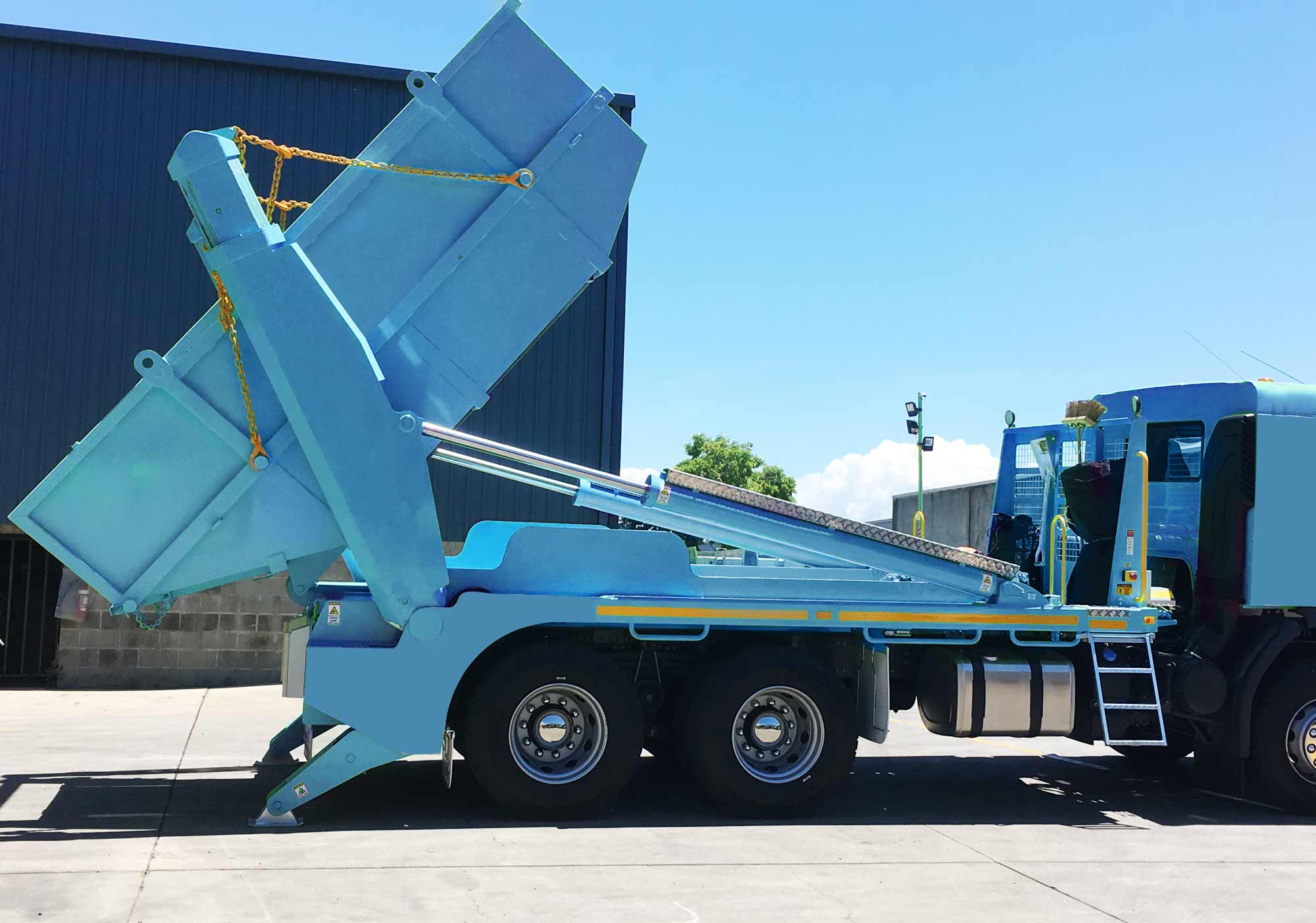
West-Trans builds skip loaders from 4,000kg up to 15,000kg capacity:
| Model | Capacity | Deck Length | Typical Bin Size | GVM Range |
| DS-40s | 4,000kg | 3.85m | 2–4m³ | 7,500–10,000kg |
| DS-40 Bi-Fold | 4,000kg | 3.85m | 2–4m³ | 7,500–10,000kg |
| DS-60s | 6,000kg | 4.2m | 4–6m³ | 10,400–13,000kg |
| DS-80s | 8,000kg | 4.3m | 8m³ | 14,000kg |
| DS-120s-S/P | 12,000kg | 4.3m | 8m³ | 15,000–16,000kg |
| MXS-150 | 15,000kg | 5m | up to 12m³ | 24,000–26,000kg |
The DS-40s and DS-60s suit urban waste collection and landscaping. The DS-40 Bi-Fold has bi-folding arms that work in tight spaces with low clearances.
DS-80s and DS-120s models handle commercial construction and demolition work. The DS-120s comes in two versions: sliding stabiliser legs (S) or pivoting legs (P).
The MXS-150 is the heavy-duty option for major construction projects and high-volume operations. It comes standard with radio remote control.
How to Calculate Your Actual Payload Limit
Start with your truck’s GVM from the capacity plate. Weigh your complete truck with an empty skip bin, full fuel, and driver at a weighbridge. Don’t estimate this.
Subtract tare weight from GVM. That’s your available payload. For example:
- GVM: 10,000kg
- Tare weight: 5,800kg
- Available payload: 4,200kg
Now factor in your skip bin weight. If the bin weighs 400kg, your material capacity drops to 3,800kg.
Calculate material weight using density tables:
Skip Bin Volume (m³) × Material Density (kg/m³) = Load Weight
Example: 4m³ bin with wet clay
- 4m³ × 1,660kg/m³ = 6,640kg
That’s way over capacity for a DS-40s, even though the 4m³ bin seems like a good match for the loader size.
Never load to 100% capacity. Target 85-90% maximum to allow for moisture content changes and density variations. Soil that seemed dry when loaded can gain 20-30% weight if it rains before pickup.
Common Overloading Mistakes That Wreck Equipment
- Forgetting skip bin weight is the number one error. Operators calculate based on material only and forget that the bin uses up 200-500kg of capacity.
- Filling bins completely with dense materials destroys hydraulics. Don’t fill an 8m³ bin to the top with wet clay just because it fits. The weight will exceed safe capacity.
- Ignoring moisture content causes surprise overloads. Dry excavated soil becomes heavy wet soil after rain. That weight change can push you from legal to overloaded overnight.
- Using wrong bin sizes for material types sets you up to fail. An 8m³ bin might suit a DS-80s for light waste, but fill it with crushed concrete, and you’re carrying 12,800kg on an 8,000kg loader.
Managing Capacity On Site
Check your capacity plate daily during pre-start inspections. Make sure it’s legible and matches your chassis specs.
Mark skip bins with fill lines for different waste removal. Paint “MAX – Dense Materials” and “MAX – Light Materials” lines so loading crews know when to stop.
Use weighbridges for critical loads or when handling dense materials and heavy loads. Visual estimates aren’t good enough for legal compliance or equipment protection.
Deploy stabiliser legs fully before every lift. They steady the truck during operation, but don’t compensate for overloading or poor ground conditions.
Document your capacity calculations when carrying loads near your limits. If you’re at 95% capacity, record your calculations showing you verified payload, material density, and bin weight. This documentation protects you if accidents happen or regulators audit your operations.
Choosing the Right Skip Loader Capacity
Look at what you actually handle over three months. If 80% of your work involves 4m³ bins with mixed construction materials and waste, a DS-60s suits better than a DS-40s. The extra capacity gives you an operating margin for occasional denser loads.
Consider how many lifts you do daily. High-volume operations benefit from radio remote control and features that reduce cycle times. The DS-120s range handles heavy use. Lighter models work fine for 5-8 lifts per day.
Don’t buy excess capacity for work you might get someday. But don’t try running heavy-duty operations with light-duty equipment either. A DS-40s costs less than an MXS-150, but using it for work it can’t handle destroys equipment and creates safety risks.
West-Trans skip loaders use high-tensile steel construction with anti-corrosion primer and two-pack colour finish. They’re built for Australian conditions. Most models offer radio remote control as an option (standard on MXS-150), plus various tarping systems and extended deck designs.
Get Capacity Right to Protect Your Business
Skip loader weight capacity isn’t complicated once you understand the three numbers: lifting capacity, skip bin weight, and GVM. The calculations are straightforward. Verify your GVM, subtract tare weight, account for bin weight, then calculate material density.
The hard part is discipline. You need to do these calculations before every load, even when you think you know the weight by looking.
Chain of Responsibility legislation makes this a legal requirement. That’s enough to end your operation.
Get capacity decisions right, and your skip loader makes money for years. Get them wrong, and you’re facing equipment damage, fines, and safety incidents.
For help selecting the right skip loader capacity for your operations, contact West-Trans.