
Most people know hook lifts for waste bins, and that makes sense. It’s where a lot of them spend their working lives. But if you think waste containers are the only thing a hook lift can handle, you’re selling the system short.
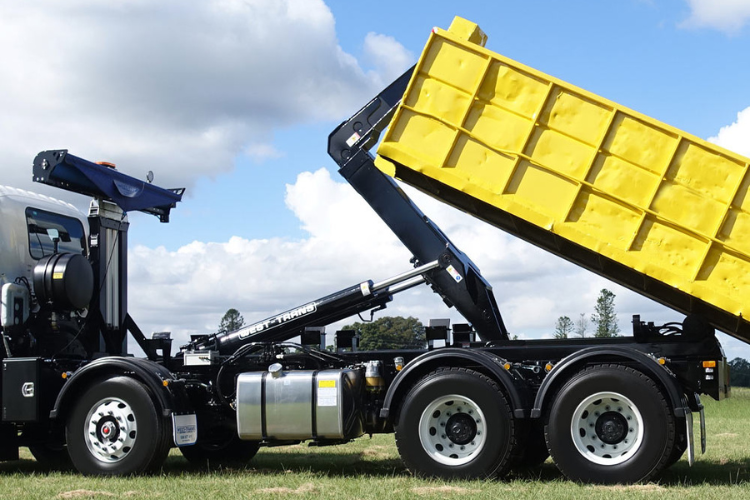
A hook lift uses a hydraulic jib to load and unload demountable bodies at ground level, rolling them on and off the truck chassis. Changeovers are quick, which means a single truck can switch between completely different body types throughout the day.
That opens the door to everything from standard waste bins and tipper bodies through to flatbeds, sealed containers, tanker units and purpose-built setups. Rather than tying up three or four single-purpose trucks, one hook lift with the right range of bodies can run waste collection in the morning, material haulage after lunch, and equipment transport before knock-off.
Below, we’ve covered every major container and body type used with hook lift systems across Australian industries, including a few that might change the way you think about your fleet. West-Trans manufactures the hook lift systems, while the containers and bodies that sit on them are sourced separately to suit your operation.
Standard Hook Lift Containers and Bins
Contractor-Duty Containers
Heavy-duty steel bins with side stiffeners and inverted angle top rails, built to handle construction debris, industrial or residential waste and other heavy loads. They’re the workhorse of skip bin hire and demolition operations, designed to withstand heavy excavator loading without buckling.
Standard Waste and Skip Bins
Range from around 6m³ to 30m³ and beyond, depending on your hook lift’s capacity and bin length. These are the containers councils, waste hauliers, and recycling operators rely on for high-turnover general waste collection.
High-Side Containers
Have taller walls to maximise volume for bulkier, lighter materials such as green waste, packaging, and insulation. If your operation handles a lot of low-density loads, high-side bins let you carry more per trip.
Compaction Containers
Integrate with stationary compaction units at transfer stations and high-volume waste facilities. They suit commercial and industrial operations where waste volumes are too high for standard open-top bins.
Dump Bodies and Tipper Bins
A hook lift dump body expands what your truck can haul well beyond waste. These hook lift bodies carry gravel, sand, soil, mulch, stone and other materials, using the hook lift’s hydraulic system to tilt and tip the load at the drop-off point.
High-side dump bodies handle bulkier loads like demolition rubble and mixed debris, while landscape dump bodies sit lower with flip-down sides for easy loading of mowers, equipment and landscaping materials.
Take a small earthmoving company, for example. They load soil into a tipper body in the morning, swap to a standard bin for demolition waste after lunch, and run a flatbed body for equipment transport the following day. One truck, one driver, three completely different jobs. That kind of flexibility reduces fleet size, registration costs, and fuel spend in ways that single-purpose trucks simply can’t match.
Flatbed Bodies
Flatbed hook lift bodies open up a whole different category of work. They’re used for carrying vehicles, farming equipment, timber, steel, plywood and other materials that don’t suit an enclosed bin.
A demountable flatbed is a practical option for rural operators who need to haul machinery to a job site one day and swap over to a bin for material removal the next, all without a second vehicle. Because hook lifts load and unload at ground level, driving equipment onto the flatbed is safer and more straightforward than working with ramps on a dedicated tray truck.
Owning a flatbed body to swap onto your existing hook lift is considerably cheaper than purchasing and maintaining a separate flatbed truck, which makes it a practical option for operations that need flatbed capability but can’t justify a dedicated truck.
Specialist Containers and Industry-Specific Bodies
Beyond the standard bins and dump bodies, hook lift systems open up a range of specialist applications that most operators don’t initially consider.
| Body Type | What It Carries | Common Industries |
| Sealed containers | Wet loads, sludge, liquid waste. Sealed gates prevent leakage during transport. | Wastewater, industrial cleaning, liquid waste removal |
| Tanker bodies | Water for cartage, dust suppression and firefighting applications | Construction sites, mining, remote operations |
| Poly (polymer) boxes | Hazardous materials are too acidic or corrosive for steel containers | Chemical handling, industrial cleaning, and specialist waste |
| Recycling containers | Cardboard, aluminium cans, glass bottles, plastic goods. Available with interior dividers and various lid and roof configurations. | Councils, recycling operators, waste management |
| Heavy-duty scrap bodies | Scrap metal, concrete, bricks, drywall and other heavy loads | Demolition, recycling, construction |
For operations that need water delivery alongside their regular container work, pairing a tanker body with your hook lift eliminates the need for a dedicated water truck to sit idle between jobs. Poly boxes also solve a specific problem, carrying materials that would eat through a standard steel container.
And for recycling operators, the ability to configure interior dividers and lid types means that one container can be set up to match specific on-site sorting requirements.
Emerging and Custom Applications
The traditional association between hook lifts and waste management is well earned, but innovative operators across Australia are pushing these systems into new territory.
Custom-built hook lift bodies are now being used for excavator transport (loaded into tipper-style bins and lifted onto the truck), mobile workshop setups, and even concrete mixer bodies for delivering ready-mix to remote construction sites. In mining and exploration, hook lifts are proving valuable for hauling equipment and supplies where road conditions are tough and flexibility matters.
Dog trailer combinations are another area seeing strong growth. By pairing a hook lift with a dog trailer, operators can double their carrying capacity per trip. On routes where the truck is travelling several hours between pickup and drop-off, the time spent loading a second bin onto the trailer far outweighs the cost of making multiple trips.
It’s also worth noting how hook lift systems compare to roll-off trucks, which use a cable-and-winch mechanism rather than a hydraulic hook lift system. Roll-off trucks are largely considered older technology in Australia and are no longer commonly manufactured here. Hook lifts offer broader body compatibility because they don’t require wheeled or rollered containers, and their hydraulic system with safety locks provides more secure load handling during transport.
Matching the Right Body to Your Operation
Choosing the right hook lift bodies and containers comes down to a handful of practical factors, including the type of material you’re carrying (dry solids, liquids, hazardous, mixed), the weight of your typical loads, and how frequently you’ll be swapping between body types.
West-Trans hook lift systems range from a 6,000 kg lifting capacity on the compact HL-6 to 26,000 kg on the HL-26A, with bin lengths from 3,000 mm to 7,400 mm. That means there’s a system to match virtually any container or body type used in Australian operations, and all machinery complies with Australian Standards and ADRs.
The real cost advantage is in the maths. Running multiple demountable bodies on one hook lift truck is significantly cheaper than purchasing, registering, insuring and maintaining multiple trucks. Fewer trucks, fewer drivers, less downtime, and more flexibility to take on whatever job comes next.
Talk to the Hook Lift Experts
If you’re looking to get more out of your hook lift, or considering one for the first time, get in touch with the friendly West-Trans team to discuss which containers and bodies suit your operation. With hook lift systems built tough for Australian conditions and an extensive dealer network across Sydney, Melbourne, Brisbane and Perth, West-Trans can help you find the right setup. Explore our full hook lift range or call 1300 877 411.